
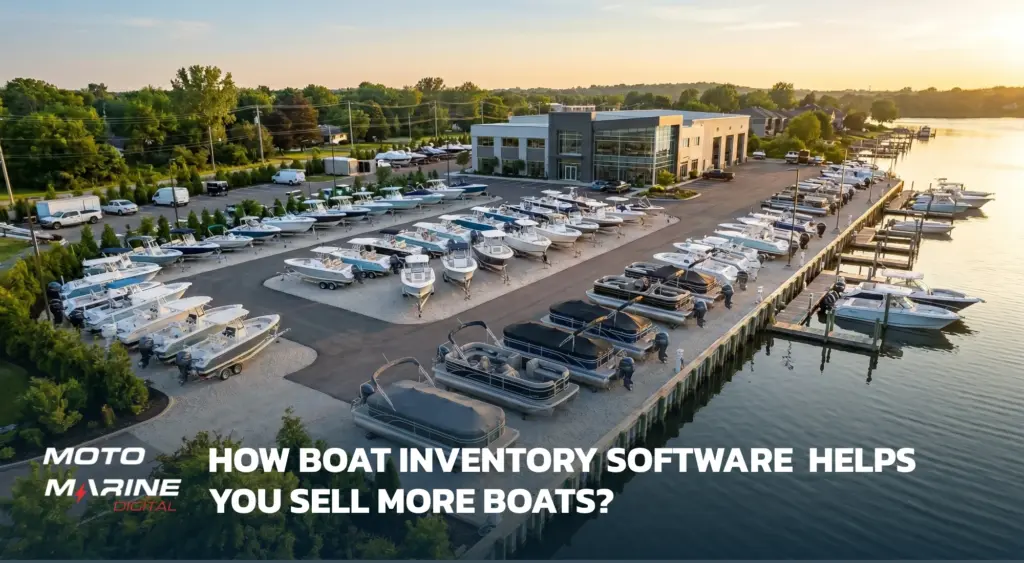
New powerboat retail sales hit 231,576 units in 2024, down roughly 9% from the year before, while pre-owned moved 858,798 units, almost four times the new-boat volume. That’s the lot most independent dealers are actually selling from. And for every dealer pulling steady leads off their inventory, there’s another one wondering why the same listings on the same boats produce nothing.
The difference usually isn’t the boats. It’s the inventory software stack underneath them, and how well it connects to the place buyers actually look. If you’re evaluating boat inventory software right now, this is the piece worth reading before you sign anything.
When dealers shop for “boat inventory software,” they usually end up looking at three different things. The DMS that runs the back office. The website layer that puts inventory in front of buyers. And the marketplace tools that push listings to Boat Trader and others. All three matter, all three have to talk to each other, and most dealers have at least one of them quietly failing.
Six Jobs Your Inventory Software has to Do Well
Stock Stays Accurate Across Every Channel
When a boat sells on Friday afternoon, it disappears from your website, your Boat Trader listings, and your sales team’s pipeline before Monday morning. No phantom inventory generating leads you can’t close.
Deals Are Tracked The Way Boat Deals Actually Work
A boat sale isn’t a single line item. Hull, engine, trailer, and accessories all need tracking as separate components inside the same deal, each with serial numbers, each priced individually. Software built for car dealers handles this badly.
Search And Filters Think The Way Buyers Think
Buyers filter by length, type, engine, price, condition, and year. Not your internal stock categories. If the search is built around how a dealer organizes a lot, the buyer leaves.
Every Listing Has A URL That Google Can Rank
Every boat needs a clean, indexable URL Google can rank. A 2025 Yamaha FSH Sport 210 living at a random numbered link won’t show up when a Tampa buyer searches for it. A structured URL will.
The Ask Lives On The Boat Page
Inquiry form, call button, financing question link, all sitting on the boat page itself. Not on a separate contact page that nobody finds.
The Phone Experience Is The Actual Experience
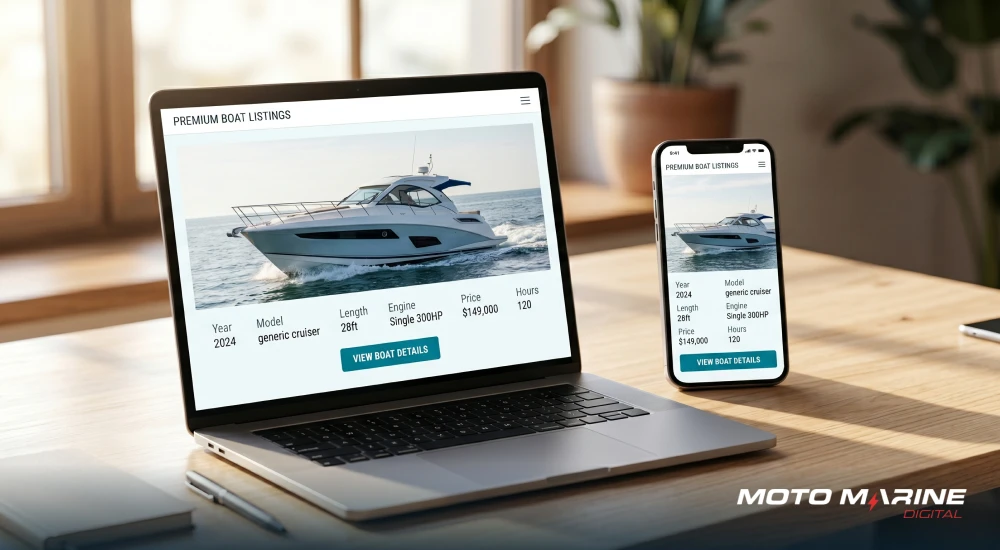
Roughly two-thirds of marine shopping traffic is on a phone. If your listing pages pinch, zoom, or load in six seconds, you’re losing buyers before they ever see the boat.
Three Places Dealers Leak Leads from Their Own Inventory
Most marine dealers think they have an inventory problem. They look at slow weeks and assume they need more units, better pricing, or a different mix. Sometimes that’s true. Often it isn’t. The real leak is somewhere in the inventory software stack, and three failures show up over and over:
- The website inventory feed is stale. Most general web agencies connect to dealer inventory through a third-party feed that updates once a day at most. Sold boats sit on the site for 48 hours. New arrivals take just as long to appear. The data on the site doesn’t match the DMS, and buyers eventually figure that out.
- The listings don’t connect to a clear next step. A buyer lands on a 2023 Tracker 175TXW, gets interested, looks for what to do next, and finds a generic “Contact Us” link buried in the footer. So they bounce.
- The website itself was built for someone else. A lot of dealer sites are spun off automotive templates with a marine skin, or built by general agencies that treat a $35,000 vessel the way they’d treat a t-shirt store. The buyer journey was never designed for boat shopping.
The Numbers Your Inventory Software has to Perform Against
| DATA POINT | WHAT IT MEANS FOR YOUR DEALERSHIP | SOURCES |
| 231,576 new powerboat units sold in 2024 | New volume is down. Used and brokerage have to pick up the slack on your site. | NMMA, March 2025 |
| 858,798 pre-owned units sold in 2024 | Pre-owned is 78.3% of all boat transactions. Your inventory page does the heaviest lifting on the used side. | NMMA Statistical Abstract, 2024 |
| $55.6 billion in total marine retail spending in 2024 | The money is still in the water. It’s the buyer’s discovery path that’s changed. | NMMA, September 2025 |
| 35 million prospective owners in the U.S. | Ipsos research released in early 2026 found that many consumers say they’re at least 50% likely to buy a boat. Their path to purchase is “digital-first and self-directed.” | NMMA and MRAA, Ipsos 2026 |
| 61% of boat buyers earn under $100K | The buyer browsing your pontoon listing at midnight isn’t a yacht buyer. They want a payment they can afford and a process that doesn’t waste their time. | NMMA, Frank Hugelmeyer 2025 |
The Ipsos research is the one worth sitting with. Trust still comes down to the dealer, but the buyer’s search now starts on YouTube, social, and dealer websites long before a phone call. If your inventory pages aren’t doing that early work, a competitor’s pages are.
Questions to Put to Any Vendor Before You Sign
How often does the DMS feed the website?
Once-daily isn’t enough if you sell in volume. A boat that sold Tuesday morning shouldn’t be generating leads Tuesday afternoon. Ask how often the feed updates and what happens to sold units.
What URL does every listing get?
Do listings get structured, SEO-friendly URLs? This directly affects whether Google indexes and ranks your inventory. Raw data feeds don’t deliver this.
Does it handle hull, engine, and trailer together?
Does it track hull, engine, and trailer as connected components inside the same deal? Software built for automotive handles this badly.
Does it push to Boat Trader automatically?
Does it push to Boat Trader and other marketplaces automatically? Manual uploads are where listings go stale.
What does the listing look like on a phone?
Ask for a live demo on a phone, not a desktop screenshot. Roughly two-thirds of your traffic is mobile, so the listing experience there is where most of your leads are won or lost.
What are the actual PageSpeed scores?
Ask for actual PageSpeed numbers, not just feature lists. Site speed affects rankings, conversions, and bounce rate.
Where does the lead actually land
A listing without a clear lead path is decoration. Inquiry forms and call buttons should sit on the listing page itself, not on a separate contact page.
Where Does Moto Marine Digital Sit in this Stack?
Moto Marine Digital is a website inventory platform, not a DMS. It pulls inventory data from whichever DMS your dealership runs, generates SEO-friendly URLs for every listing, runs lead capture on every boat page, and pushes clean listings to Boat Trader and other marketplaces.
The platform connects with the major marine DMS systems, with a select partnership on the Winboats side that keeps that specific integration especially tight. Winboats is the DMS used by many of the Boating Industry Top 100 dealers across the US, Canada, and Mexico, and the sync runs twice a day. Your DMS keeps your stock accurate. The website platform turns that stock into leads.
What’s Different About the Platform
- Inventory is the hero of the site. Listings sit at the top of the experience, not behind a navigation menu.
- Mobile-first from the ground up. Designed around the phone first, not adapted later.
- Lead capture on every listing page. Inquiry form, call button, financing link, all on the boat page itself.
- FlexiFind Search. Typo-tolerant search. A shopper typing “2023 yam 222” still pulls up the 2023 Yamaha 222 FSH.
- Built only for marine dealerships. Every product decision reflects how dealers actually sell boats and how buyers actually shop.
The SEO Behind the Build
The SEO work isn’t bolted on. The PixelChefs team has 15 years of technical SEO behind it, and Alex Alexakis, who founded the company, ran SEO for Westgate Resorts and Mossy Oak Properties before turning that work toward the marine industry. The same SEO foundation ships with every Moto Marine Digital build.
Your Inventory Is Only As Good As How It Shows Up Online
Inventory alone doesn’t sell boats. Fifty listings on your site mean very little if buyers can’t find the right one fast, evaluate it without calling, and take the next step without hunting for it. The gap between traffic and leads is almost always about how the inventory shows up on the website, not how much of it you have or how well your DMS tracks it.
The dealers pulling ahead right now aren’t always the ones with the biggest stock or the lowest prices. They’re the ones who’ve made the path from browsing on a phone to talking to a salesperson as short as possible. That’s a website job before it’s a sales job.
If your inventory pages aren’t ranking, your DMS feed breaks every other week, or your mobile load times are eating your weekend traffic, Moto Marine Digital is worth a 30-minute demo. The team can pull your site’s current Core Web Vitals scores and walk you through what changes.
Sources
- National Marine Manufacturers Association. 2024 new powerboat retail unit sales data. nmma.org/press/article/24937
- NMMA. 2024 Total Industry Sales by Category and State Report. $55.6 billion in retail expenditures and 858,798 pre-owned units sold. nmma.org/press/article/25236
- NMMA Statistical Abstract. 61% of boaters with household income under $100,000. nmma.org/statistics/publications/statistical-abstract
- NMMA and MRAA. Ipsos research on 35 million prospective boat owners, March 2026. nmma.org/press/article/25427
- MRAA. Ipsos research summary on boater trends and market growth. mraa.com/ipsos-research-boater-trends-market-growth-opportunities