
The Ipsos research NMMA and MRAA released in early 2026 put it plainly. The boat buyer’s path to purchase is now “digital-first and self-directed,” shaped by YouTube, social, online reviews, and dealer websites long before anyone picks up a phone. By the time a buyer walks onto your lot, they’ve compared your inventory against three or four competitors, read your reviews, and already decided whether you look like a professional operation. None of that happens inside your CRM. It happens on your website.
That distinction matters, and most articles in this space blur it on purpose. Software vendors have a reason to make CRM and DMS sound like the same thing. They’re not. And the gap between them is where most dealers are losing the leads they’re paying to generate.
What A Marine CRM Is Actually Built For
A CRM tracks the people your dealership has contact with. Prospects, buyers, past customers, trade show leads, and anyone who filled out a form on your website. It logs interactions, schedules follow-ups, and gives your sales team a structured way to manage the 4 to 6-month research cycle most boat buyers go through.
That cycle is where a CRM earns its keep. A buyer who walks in during March probably started researching in October. If your sales team can’t stay in front of that person across six months of browsing and cross-shopping, you’re hoping they remember you on the day they’re ready to buy. A CRM manages that window. It tracks who asked about a specific model, who requested financing info, and who came back to your site three times in two weeks. What a CRM doesn’t do is run the dealership. It doesn’t track inventory, write service work orders, sync your listings to Boat Trader, or tell a buyer searching Google what you have in stock today.
What a DMS Does That a CRM Can’t
A DMS is operational. It runs sales, service, parts, inventory, and accounting. The two places it matters most for the buyer side are inventory and the website feed.
Inventory: The Way Boat Deals Actually Work
A boat sale isn’t one line item. It’s a hull, an engine, a trailer, accessories, and financing. Every component is tracked, priced, and removed from inventory when the deal closes, then reflected accurately on your website and every marketplace you push to. A CRM has no mechanism for that. A DMS does.
The Data Your Website Is Showing Buyers
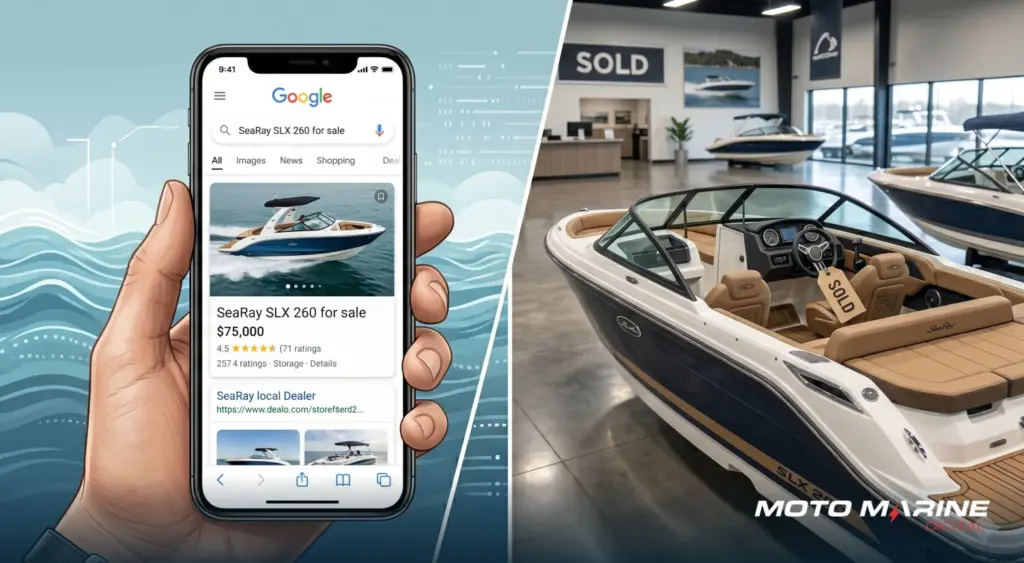
Buyers don’t call first. They search first. When someone in Tampa types “Yamaha FSH Sport for sale near me” and your listing shows up with current specs, real photos, and a price, that’s your DMS data hitting your website properly. When a sold unit stays visible on Boat Trader for three weeks after the paperwork is signed, the DMS or the website feed is broken.
Side By Side
| A CRM handles | A DMS handles |
| Contact records and lead capture | Inventory across every channel |
| Follow-ups across the buying cycle | Service work orders and parts |
| Email and outreach campaigns | Multi-location stock |
| Sales pipeline visibility | Hull, engine, trailer as connected components |
| Customer history and preferences | Accounting and QuickBooks integration |
| Communication logs | Data feed to website and marketplaces |
| Review generation follow-ups | Sold-unit removal across listings |
Most Dealers Aren’t Losing Leads In The CRM
Dealers wondering why their CRM follow-up rate is low rarely stop to ask why the top of the funnel is so thin. The honest answer is usually that the leads never made it that far.
Stale inventory feeds. Pages are loading in six seconds on mobile. Listings without photos, without specs, without a searchable model name. Google’s research found that 53% of mobile visits are abandoned if a page takes longer than 3 seconds to load, and the same Ipsos research from earlier shows boat buyers heavily cross-shop dealer websites before ever making contact. Those prospects never enter your CRM because they leave your site before they can.
Where The Website Platform Fits In The Stack
Moto Marine Digital is the website layer in this picture, not the DMS or the CRM. The platform pulls inventory data from whichever DMS your dealership runs, generates SEO-friendly URLs for every listing, runs lead capture on every boat page, and pushes clean listings to Boat Trader and other marketplaces. The leads those listings generate go straight to your inbox and into whatever CRM your sales team already uses.
How The Dms Feed Actually Flows
Most general web agencies connect to dealer inventory through a third-party feed that updates once a day at most. Listings go stale. Sold boats stay visible. Buyers click through to inventory that no longer exists and leave without submitting a lead.
Moto Marine Digital syncs twice a day, and the integration on the Winboats side runs especially clean because the company is a select partner of Winboats, the DMS used by many of the Boating Industry Top 100 dealers across the US, Canada, and Mexico.
What That Means For The Listing Itself
Every listing gets a clean, indexable URL. A 2025 Yamaha FSH Sport 210 doesn’t live at a random numbered link. It lives at a URL Google can rank and serve to buyers actively searching for that boat. The website platform handles the digital side. The CRM handles the relationship side. Neither is being asked to do the other one’s job.
Questions To Put To Any DMS Vendor Before You Sign
How often does the inventory sync
Once-daily isn’t enough if you sell in volume. A boat that sold Tuesday morning shouldn’t be generating leads Tuesday afternoon. Ask what happens to sold units and how fast they come off your listings.
What URLs do listings get on the website?
The DMS should push structured, SEO-friendly URLs, not a raw data dump. Structured URLs affect rankings directly. A raw feed doesn’t.
Does it handle hull, engine, and trailer together?
A boat deal involves multiple components tracked as one transaction. Software built for car dealers handles this badly. The platform should track boats, motors, and trailers as distinct line items inside the same deal.
Does it push to Boat Trader automatically?
Inventory should hit Boat Trader and other marketplaces without anyone uploading anything by hand. Manual uploads are where listings go stale.
Does service history connect to sales?
A customer bringing their boat in for winterization is a warm prospect for an upgrade next spring. If the DMS can’t link service history to the sales CRM, that opportunity sits on the table.
What are the PageSpeed scores on inventory pages?
If your inventory pages load slowly because the feed isn’t optimized, your Google rankings suffer before a buyer ever sees the listing. Ask for actual numbers, not feature lists.
What Good CRM Use Looks Like On Top Of All This
A CRM works best when it sits on top of a website and DMS that are pulling their weight. The 4 to 6 month buying cycle is a long time to stay relevant, and good CRM practice means structured touchpoints across that window. A follow-up email with comparable models two weeks after the first inquiry. A seasonal finance offer in early spring. A service reminder that doubles as a check-in before the selling season opens.
The dealers who do this well aren’t running fancier software than anyone else. They’re running a consistent process. They capture the lead when a buyer engages with inventory, log the specific models viewed, follow up with information that matches what the buyer was looking at, and stay present through the research period without getting aggressive.
NMMA’s 2024 abstract shows boat sales peaking in late spring and early summer, with December accounting for just 3% of the year. Most dealers run the same marketing all year. Building a CRM follow-up sequence that accounts for that seasonality, warming leads in January and February so they convert in March through June, is more useful than most feature upgrades a vendor will pitch you.
The Website Is Where Most Of The Race Is Won
Every DMS vendor sells the idea that better back-office operations grow your dealership. That’s partly true. But the difference between dealers ranking on page one and dealers stuck on page three isn’t which DMS they use internally. It’s whether their website generates search traffic, whether their listings convert browsers into leads, and whether those leads arrive with enough context for the sales team to follow up on something specific.
That’s the seam Moto Marine Digital is built for. The platform handles the SEO, the site speed, the structured inventory URLs, the lead capture tools, and the feed to Boat Trader. The DMS handles the operational side. Your CRM handles the follow-up. Each piece does its job.
If your DMS and your website aren’t talking to each other, or your site doesn’t reflect what’s actually on your lot, that’s where leads are getting lost. Not in the CRM.
Sources
- Google. “The need for mobile speed” research, 53% mobile abandonment after 3 seconds. blog.google/products/admanager/the-need-for-mobile-speed
- NMMA and MRAA. Ipsos research on boat buyer behavior and the digital-first path to purchase, March 2026. nmma.org/press/article/25427
- NMMA. 2024 U.S. Recreational Boating Statistical Abstract. Seasonality and pre-owned vs new boat sales data. nmma.org/press/article/25236
- MRAA. Ipsos research summary on boater trends and market growth. mraa.com/ipsos-research-boater-trends-market-growth-opportunities